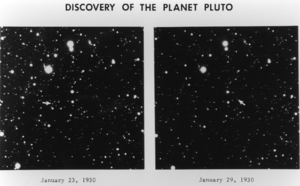
Our Solar System used to be quite a simple place with 8 planets (Pluto was discovered in 1936), and a few moons. Life was simpler too.
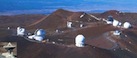
Since, the tremendous growth of Astronomical observations since the 19th century, including Maunatele -- seen left, and the rest of the Deep Space Network, we have learned more and more about how unbelievably complex our Solar System really is.
Thus, it has become almost impossible to classify the hundreds of thousands (probably millions) of objects that orbit our sun into reasonable groups. The International Astronomical Union (one of the most unreasonable groups in the Solar System), is responsible for classification schemes, but we are learning so much, so fast, that the naming schemes change frequently and driving this group potty.
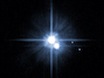
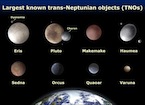
Even the larger objects, such as planets, have been classified and reclassified over the years. For example, Pluto (left) was reclassified as a minor or dwarf planet in 2006. And some moons are larger than the planet Mercury!
So what I show here is likely to change next week. (I'll try to keep up with the changes). Well, here's one. We have just discovered that Pluto has an atmosphere that is slightly warmer than its surface. Using the European Southern Observatory, astronomers have taken the most detailed readings of the surface of this distant -- whateveryouwantocallit.
I will simply use the term "minor planet" to refer to all of the larger objects that orbit the sun. The rate of discovery of new minor planets is currently running at around 5,000 per month. Of the more than 400,000 registered minor planets, 192,280 have orbits known well enough to be assigned permanent official numbers. Of these, 14,698 have official names. Currently, minor planets fall into several broad populations, and I'll try to keep this simple:
Consider a journey outward from the sun. We would encounter the following objects on the way:
Near Earth Asteroids, those whose orbits take them inside the orbit of Mars. These are sub-classified -- generally along the lines of whether they put Earth at risk. These objects at some point cross the plane where Earth rotates around the sun. If Earth happens to be at the same place at the same time as the NEO, we have a problem. This happens a lot. Look at the great Crater Lake on Earth, and all the pockmarks (craters) on the moon!
Aten asteroids: We used to think that Asteroids only orbited between the orbit of Mars and Jupiter. Aten asteroids orbit the sun at a distance less than, or equal to that of the Earth. We have to watch out for these too. Those Aten asteroids that can cross Earth's orbit (with the possibility of a collision) are known as Apohele asteroids. So far, not been many of these have been identified.
Amor asteroids are those near-Earth asteroids that approach the orbit of the Earth from beyond, but do not cross it. Amor asteroids are further subdivided into four subgroups, depending on where their orbit falls between Earth's orbit and the main asteroid belt.
Apollo asteroids are those asteroids with an oval orbit around but that also cross the plane of the Earth. Like Aten asteroids, Apollo asteroids are Earth-crushers.
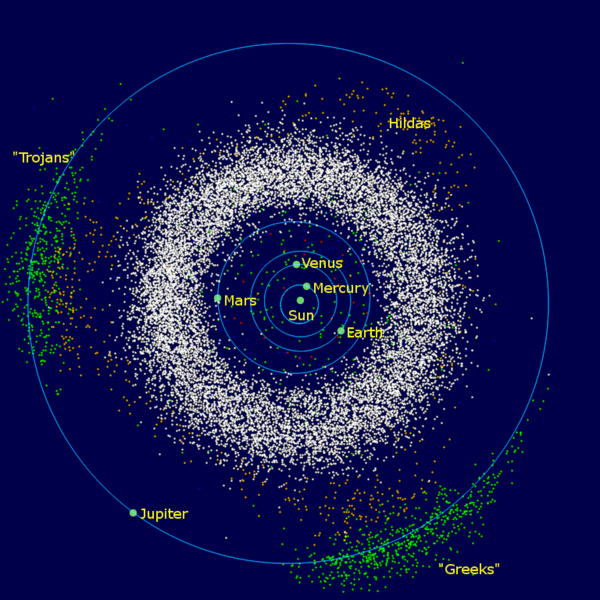
Beyond Mars, we would soon encounter Main belt Asteroids, those following roughly circular orbits between Mars and Jupiter. These are the original and best known group of asteroids and minor planets. Jupiter Trojans and Greeks are a subset of Main belt Asteroids These are two groups of asteroids sharing Jupiter's orbit and gravitationally locked to it. Numerically they are estimated to equal the main-belt asteroids. So -- countless thousands. They don't threaten Earth unless, something big, like a comet, hits one and knocks it our way.
Moving further out, we would encounter Centaurs. These are bodies in the outer solar system between Jupiter and Neptune. They have unstable orbits due to the influence of the giant planets' gravity, and we think today that they must have originated from elsewhere, probably outside Neptune. A billion or two miles along......
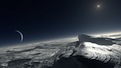
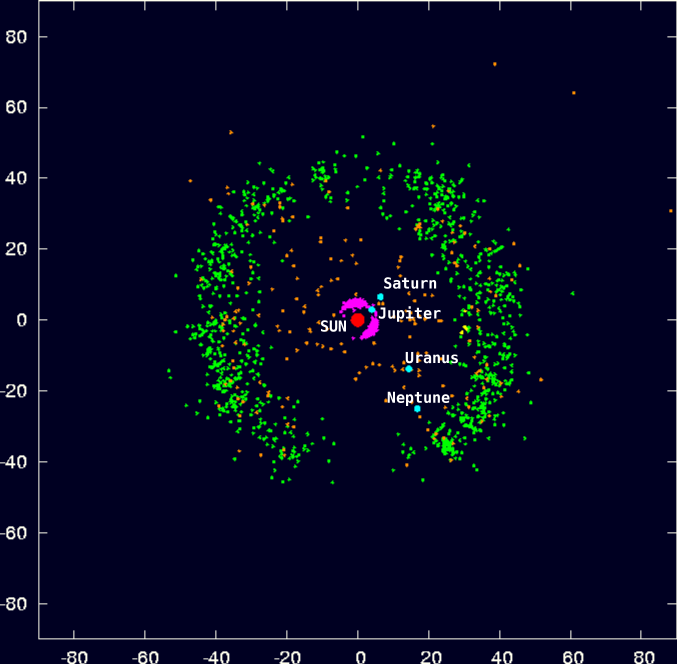
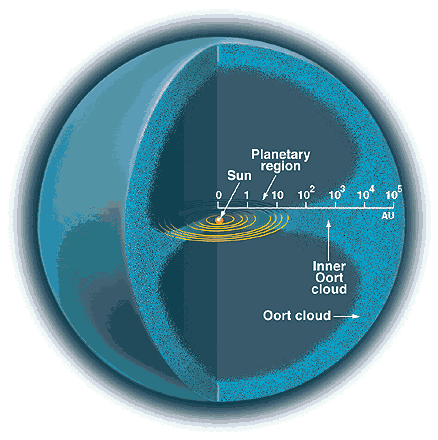
We find ourselves in the realm of "Trans-Neptunian Objects". These refer to any object in the solar system that orbits the sun at a greater distance on average than Neptune. The Kuiper belt, scattered disk objects, and the Oort cloud (see below) are three divisions of this volume of space. As you can see from the picture on the left, we have imaged "several" Pluto-like TNO bodies. Some share Neptune's orbit and gravitationally locked to it. Others, like Pluto, are in a rough plane with Neptune. Sometimes they orbit within the Neptune's orbit, sometimes outside. There are now thought to outnumber main-belt asteroids by an order of magnitude. So if we think of say, 1,000,000 of these moon-sized (or much larger) objects, a) it's understandable why Pluto was demoted, and b) it makes our Solar System vastly more complex than we'd ever imagined!
Even further out, The Kuiper belt is thought to hold primordial objects, such as "Cubewanos", in relatively circular orbits. But the Solar System doesn''t end there. We think that even further out, there are Scattered objects that are also disks like planets and moons that are thought to have been captured and then tossed by Neptune's gravity. These are called for some reason "Scattered Disk Objects".
Then we enter the realm of "Detached Minor Planets" such as Sedna, that orbit in as close as Neptune and journey outside the Kuiper belt.
Finally, the Oort Cloud remains the hypothetical source of comets.
Phew. Did you get all that?
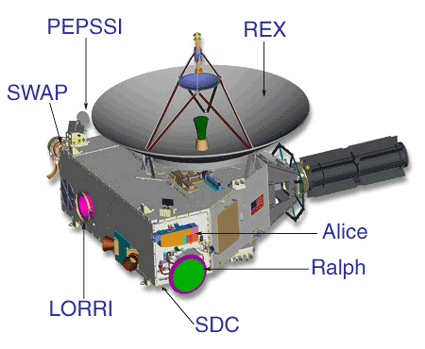
Our eyes will be opened in the near future as NASA has two spacecraft on their way. Dawn will visit Vesta, (a Main Belt Asteroid) where it will perform orbital research for two years, then it will fly on to Ceres (a Main Belt Minor Planet), where it will orbit and research for a further two years. After that - it may be re-programmed to go elsewhere!! Second, the New Horizons spacecraft is going to Pluto (which we now know has at least 3 moons). Dawn was launched in October 2007 and will reach Vesta in 2011. New Horizons was launched in 2006 but wont reach Pluto until 2015!! This is why we need students to study engineering and science -- by the time they graduate -- these spacecraft will just be starting their research!