 is by far, the largest planet in the solar system -- it could contain all of the other planets, or 100 Earths.
 It is 1/2 billion miles from us, so as you look at the images and videos, reflect on the our abilities -- maybe some parts of our education system do work.
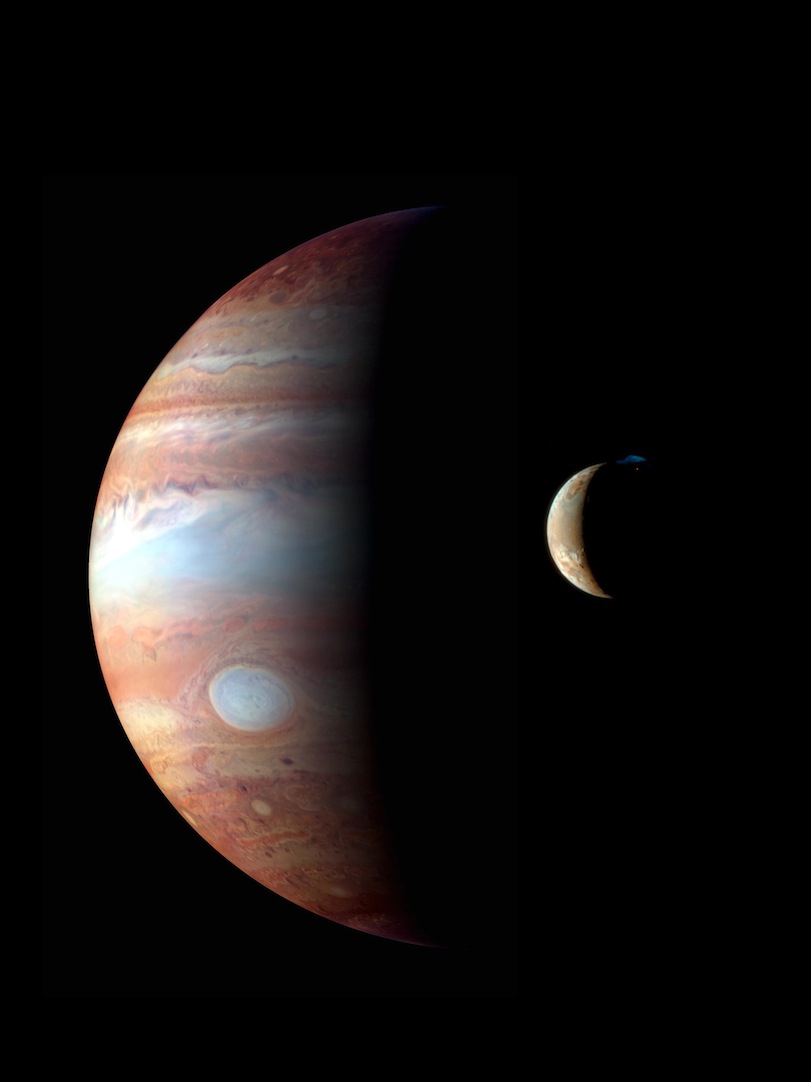
The moon of Jupiter that you can see in the picture above is Io.
Jupiter was first seen by Galileo in 1610, when he built one of the first telescopes.
Until Galileo's time in the late 1500s and early 1600s, many if not most people in the western world, thought the Earth was flat, and that all the stars, our sun, our moon rotated around us. This helped perpetuate the ease of separating heaven and hell. Heaven is up and hell is down. Simple. Well of course, they got it right about the moon. So we don't get complacent, we still refer to Dawn and Dusk as "Sunrise" and "Sunset". (Speaking of which, I have to go and walk my dog.. Be right back). OK...
This "Earth-Centric" thinking has been credited to Aristotle - the first one. The second one was self-centric, no I shouldn't say that. It doesn't do him justice. But many scientists of that early age thought the same, and arguments raged as other ancient greek astronomers, philosophers and mathematicians thought correctly, that we rotate around the sun.
But their science and math was trashed by the Romans.
So fast forward back to Galileo.
So you can imagine, this man looking through one of the first telescopes - 2000 years after Aristotle - and realizing that:
. Jupiter has moons like Earth, but more of them.
. They rotate around it, like ours rotates around us, and after years of observation, that Jupiter rotated around the sun, and therefore,
. He realized that the Earth must rotate around the sun - and by extension - that the world was also a globe.
You can imagine his senses - confusion - fear - excitement.
His writings would revolutionize thinking in the modern world in much the same way as the discoveries of Earth's continents did to the explorers of the time. BUT, the church was in no mood for revolution, and he was forced to recant his writings. He did keep studying, and the Vatican also took up Astronomy, and they have a robust observatory today.
Astronomy at that time became the rage much as the internet has revolutionized our modus operandi. More and more people built telescopes and refined observations. Within 200 years, we knew of 8 planets. In the early 20th century, we thought we had nine, with the observation of Pluto.
But now we know better.
With our observations of Jupiter, we recently saw this
 aurora around the planet's North Pole.
 We have sent 8 spacecraft to Jupiter. The Galileo Mission was the only one sent to specifically orbit the planet. (The eighth spacecraft - missing from the NASA site - is their New Horizons mission - that is on it's way to Pluto. The picture of Jupiter above was taken by NewH as it passed by Jupiter early in 2008.
The Galileo mission was not a complete success - it's main antenna malfunctioned (that's NASAese for broke), but we learned a huge amount from this journey, (there was a backup antenna) including surprising information about the planet's moons.
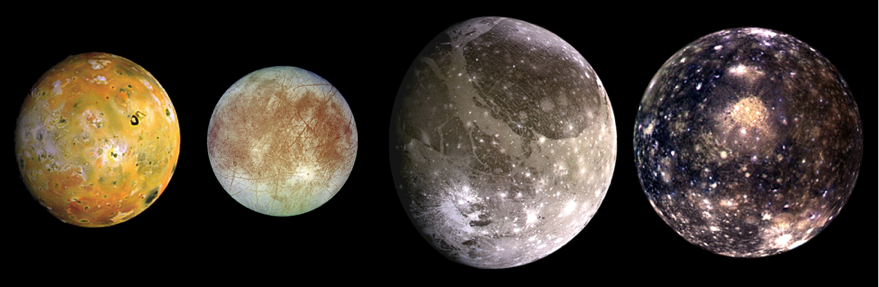
Here is a collage of the galilean moons of Jupiter. In addition to these, Jupiter has about 60 smaller moons.
This next movie is a discussion of the possibility of life on Europa
 - the second from the left. The others (left to right) are Io, Ganymede and Callisto.
Ganymede, by the way, is the largest moon in the Solar System - and is even larger than the planet Mercury. A NEW WORD ABOUT GANYMEDE. WE NOW BELIEVE (Oh sorry, I was shouting, this is exciting) - that Ganymede, is also an ice moon, and there too - is water - and we now think that the ice on Ganymede is only 200 meters deep.
Io, up to last month, was the only body other than Earth that we knew had active volcanoes. As I mentioned above we now think that Titan (moon of Saturn) may also have active volcanoes.
One last "small" detail about Jupiter. As you can see in the image below, it has a large Red Spot.
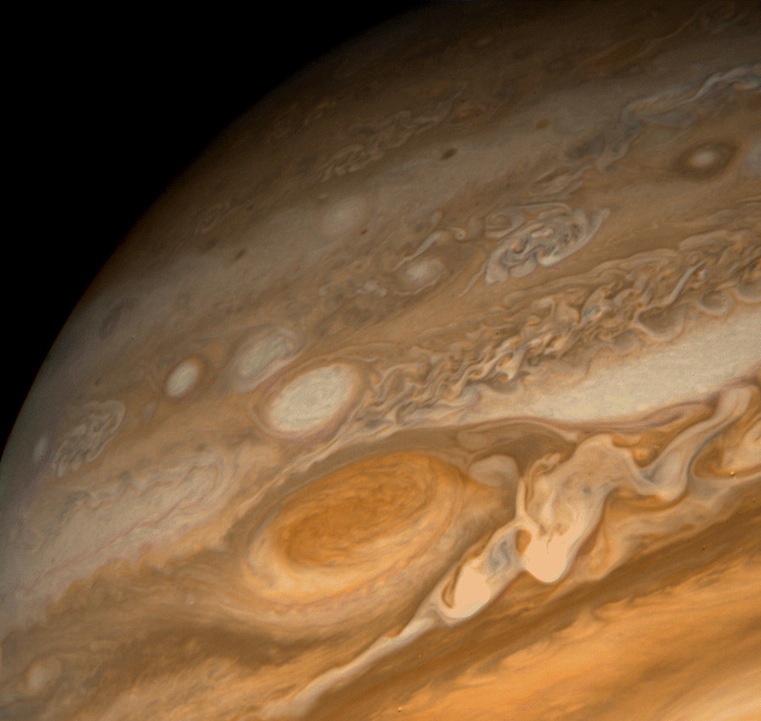
This is a storm that has lasted 400 years so far at least. How do we know this? Because Galileo saw it.
The next little movie
 shows how intense the weather is in the upper atmosphere of the planet. In the past 10-15 years, we have started to see new stable storms, one of which has been named "The little Red Spot".
OK Before we move on, I believe that we need to get the world's space programs to return to Jupiter - but together. There are several planned programs. Spread the word and get people to lobby their congress people. This is education, this is job creation, this is history in our hands. We only need the will. And it sure beats fighting each other or just having a consumer-based economy.
