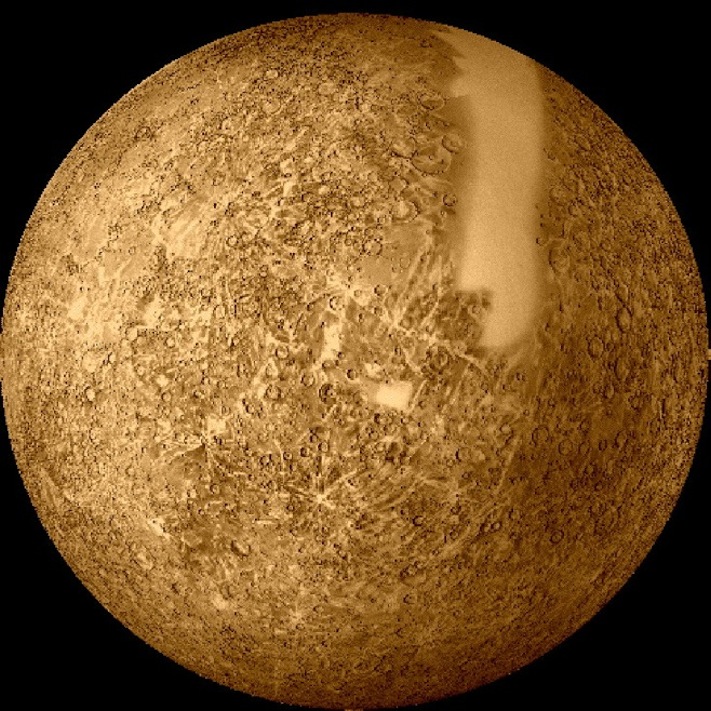
Why the difference? Up to the beginning of the 20th century, it was a huge dilemma among scientists. Many thought there must be another planet closer to the sun as every time we saw Mercury, it was in a different place. They even named the other planet Vulcan.

OK, I’m totally off my subject, as usual. So back to Mercury.
It is the smallest planet in the solar system. Some moons of Saturn and Jupiter in fact are larger!
And guess what, it’s really hot there. Well, at least on one side. We used to think that it always faced the sun with one side like the same side of the moon faces us. After visiting Mercury with two spacecraft, we now know that Mercury does rotate, like something on a spit, very slowly. It turns out that Mercury rotates 3 times in two of it’s years. It’s as if our days each lasted four months. On a cold day, the temperature dips to -300° F and on a warm day, a balmy 800° F. This is a temperature hot enough to melt tin!
Quite honestly, we don’t know a lot about Mercury because it’s difficult to observe through Earth Telescopes as it’s so close to the sun. It is even too much of a hazard to point the Hubble Space Telescope at it.
Up to a couple of years ago, we’ve only had one successful mission to the planet, Mariner 10 . This spacecraft flew by the planet three times, on February 5, 1974, March 29, 1974, and again on September 21, 1974. The closest encounter was at an altitude of 703 kilometres (437 miles)! That is CLOSE!
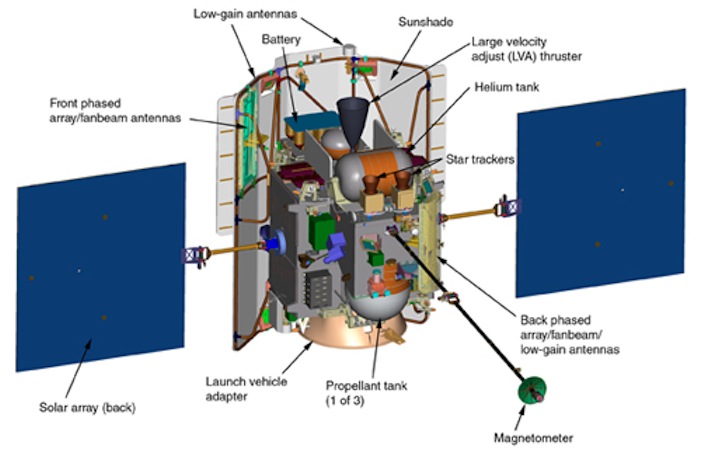
Recently, the Messenger spacecraft (above) flew by Mercury for the second time on its long voyage to orbit Venus. It sent back the pictures towards the end of this page.
What we do know is this: Scientists have detected a magnetic field surrounding Mercury, though it is not as strong as the field around the Earth. They theorize that the magnetic field is caused, either because it has a core made of iron or by the solar winds - or both.. Mercury's atmosphere is very thin and is composed of helium and sodium. The surface of Mercury has been shaped by three processes: impact cratering where large objects struck the surface resulting in crater formation, volcanism where lava flooded the surface, and tectonic activity where the planet's crust moves in order to adjust to the planetary cooling and contracting. Mercury does not have any moons.
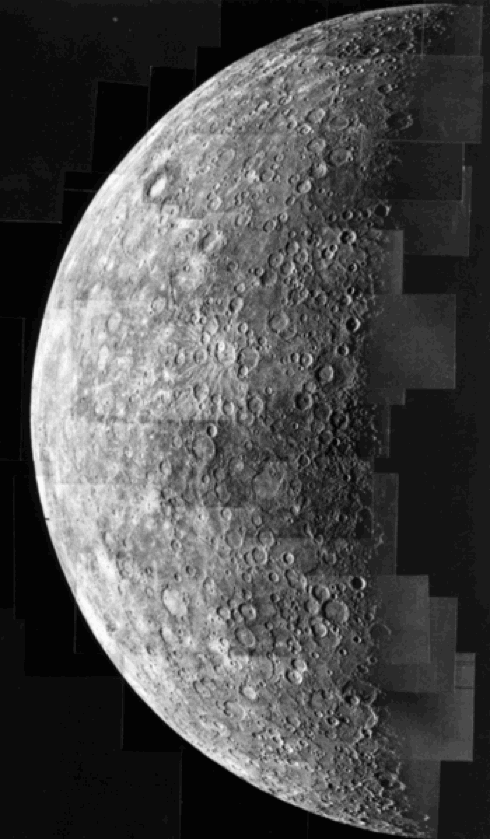
A year on Mercury is about 88 days. Here is what we have mapped on one side of Mercury. This picture was one of those sent back by Mariner:
The first spacecraft to visit Mercury was Mariner 10 which mapped about 45% of the planet. Here is another Mariner picture. Remember, that these were taken over 40 years ago and scientists are still working with the Mariner information. Now, another spacecraft is on it’s way into orbit there.
Messenger was launched in 2004 (if you want to watch the launch, click
 here), and has already flown by Mercury and Venus twice, and will finally settle into an orbit in 2011. The final orbit will be only about 120 miles above the planet’s surface! Visit the Messenger website to follow the mission. Or if you are a student graduating, consider getting involved. Messenger is operated by the John’s Hopkins University in Baltimore, Md and by the Jet Propulsion Lab (who put up with me).
 As I write this, Messenger has flown by Mercury twice, in January 2008, and October 2008. It’s scheduled to make a third and final flyby in September, 2009. Here are a couple of photographs it took of the planet. The first is looking at the sun side. The second, close to the North Pole. Note the new level of detail with high-resolution cameras.
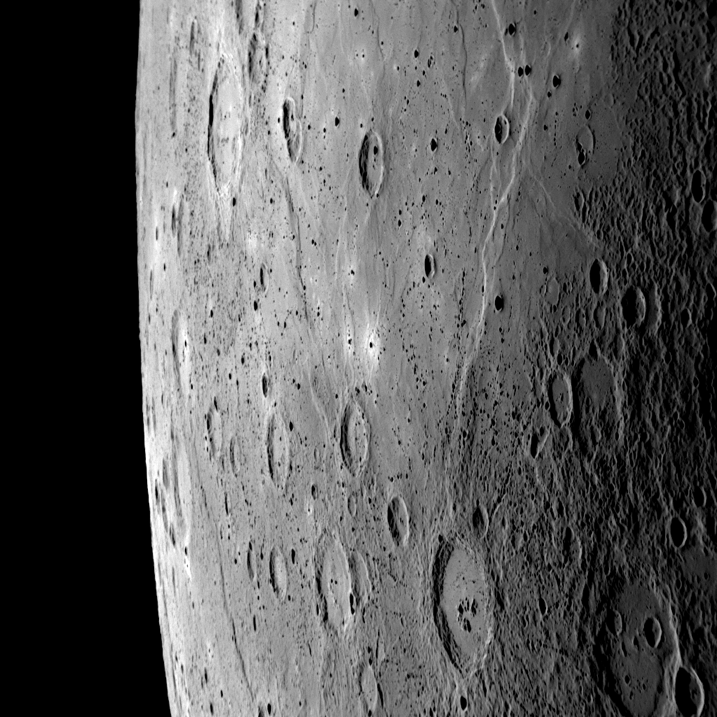
If you are a youngster in school, by the time you graduate college, there will (hopefully) be another spacecraft heading to the planet. The European Space Agency (ESA) is preparing a spacecraft called Bepi-Columbo. This will launch in 2013 and will reach Mercury in 2019. Seems a long way off, but it will go quickly, so study. All of these spacecraft take a long time to fund and to build, let alone, reach their destinations.
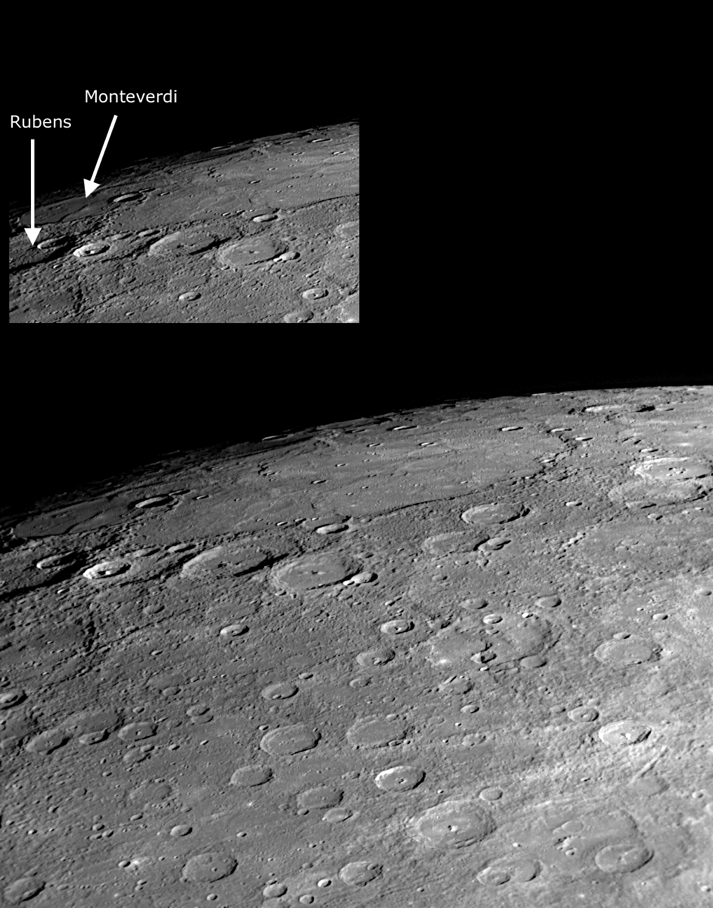
Have a look at some more pictures of Mercury at the JPL Mercury Web site, If you want to know more technical information on our inner-most planet, go here and here. There are also pages for young kids here and here.
