OUR STAR - THE SUN
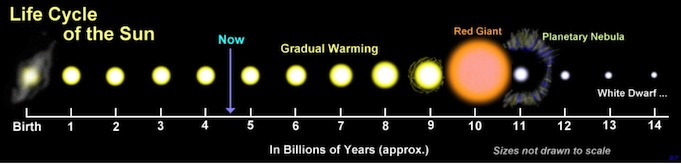
The image above shows the life cycle of our sun. Our sun is a star, just life many (billions) of other stars. There are two ways to measure stars -- their apparent brightness and by star type. Brightness is measured by "magnitude". This is a list of the brightest 150-odd stars in the sky showing the different types of stars that exist in the universe. As you can see, our star - the Sun - is only just entering middle-age. It will be another 5 billion years before the Sun becomes a Red Giant.
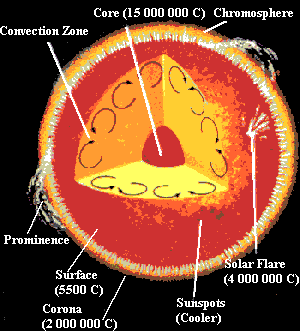
First though, what is a star? A star (like our sun) is like a huge nuclear reactor. It's really gas that has coalesced into something so heavy, its gravity not only holds it together, but creates a tremendous amount of heat and that heat is radiated. Think of the star as a giant nuclear pressure cooker.
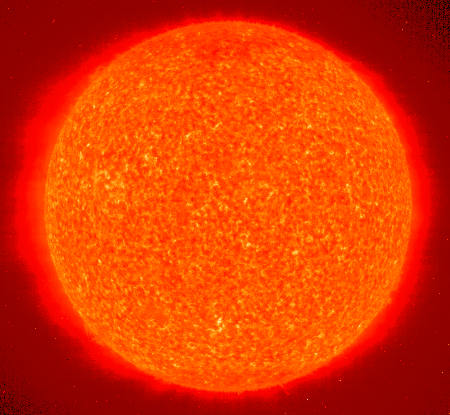
The Japanese Hinode spacecraft took this
 video of our star/sun showing it giving off giant flares that are larger than Earth. Sometimes, these erupt into "Coronal Mass Events". These "Coronal Mass Ejections" or CMEs radiate all over the place, and the winds that the sun create with its pressure and gas releases, extend to the farthest reaches of our solar system. When the solar radiation hit's Earth's atmosphere, it generally bounces off of the atmosphere or off of thick clouds. Some radiation gets through, and warms our planet and gives us light. CME's, when directed at Earth, can disrupt communications satellites, and even destroy some spacecraft. We usually have some notice of CME events by observing closely, solar activity. When there is a threat, astronauts in the Space Station must protect themselves inside the station, and extra-vehicular activities are stopped.
 This next movie explains in more detail how our sun works.
As you can see from the videos, we are researching our sun/star extensively these days, with US,ESA and Japanese spacecraft focused on it's activity, so we can better understand the effects of the sun on our climate.
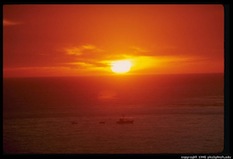
This is what a beautiful sunset looks like on Earth:
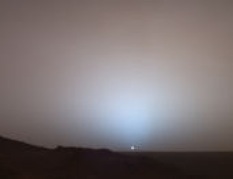
And this is what it looks like from Mars:
Our Sun is the most well-known (and most visible) example of a G V star (see above). In astronomy, a type G V star is a main-sequence star of spectral type G and luminosity class V. Like other main-sequence stars, a G V star is in the process of converting hydrogen to helium in its core by means of nuclear fusion. Each second, it fuses approximately 600 million tons of hydrogen to helium, converting about 4 million tons of matter to energy. Other G V stars include Alpha Centauri A, Tau Ceti, and 51 Pegasi.
Type G stars range in color from white, for early types like our Sun, to only slightly yellow for the later types. Our own Sun is in fact white. The misconception that it is yellow stems from its appearance through the Earth's atmosphere.
A G V star will fuse hydrogen for, very approximately, 10 billion years, until it is exhausted at the center of the star. When this happens, the star expands to many times its previous size and becomes a red giant, such as Aldebaran (Alpha Tauri). Eventually the red giant sheds its outer layers of gas, which become a planetary nebula, while the core cools and contracts into a small, dense white dwarf.
OTHER STARS
Our star is but one of hundreds of billions in our galaxy, which for some reason, we call "The Milky Way". Other cultures have called it by many other names.
There are now classifications for tons of different star types according to their size, their age and their composition.
For most of its life, a star shines due to thermonuclear fusion in its core releasing energy that traverses the star's interior and then radiates into outer space. Almost all elements heavier than hydrogen and helium were created by fusion processes in stars.
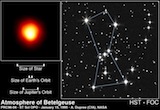
The total mass of a star is the principal determinant in its evolution and eventual fate.
Other characteristics of a star are determined by its evolutionary history, including the diameter, rotation, movement and temperature.
Stars begin as collapsing clouds of material composed primarily of hydrogen, along with helium and trace amounts of heavier elements. Once the stellar core is sufficiently dense, some of the hydrogen is steadily converted into helium through the process of nuclear fusion.
Once the hydrogen fuel at the core is exhausted, those stars having at least 0.4 times the mass of the Sun expand to become red giants,
The star then evolves into a degenerate form (like your author), recycling a portion of the matter into the interstellar environment, where it will form a new generation of stars with a higher proportion of heavy elements.
MULTI-STAR SYSTEMS
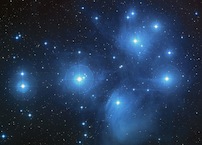
IMPACT ON OUR CULTURES
Historically, stars have been important to civilizations throughout the world.
They have been used in religious practices and for celestial navigation and orientation.
Many ancient astronomers believed that stars were permanently affixed to a heavenly sphere, and that they did not move. This inference was the popular thought in the west for over 1500 years (since the Romans).
Ancient astronomers grouped stars into constellations and used them to track the motions of the planets and the inferred position of the Sun. The motion of the Sun against the background stars (and the horizon) was used to create calendars, which could be used for agricultural practices.
The Gregorian calendar, currently used nearly everywhere in the world, is a solar calendar based on the angle of the Earth's rotational axis relative to the nearest star, our Sun.
The oldest accurately dated star chart appeared in Ancient Egypt in 1,534 BCE.
Islamic astronomers gave to many stars Arabic names which are still used today, and they invented numerous astronomical instruments which could compute the positions of the stars.
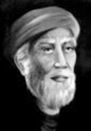
STELLAR ASTRONOMY
In this section, the message is how we humans came to rethink the nature of stars. In the late 15th century, we in the western world were just beginning to realize that we were heliocentric -- that the Earth rotated around the sun, and not geocentric -- that everything rotated around Earth. This was a major change in human thought. Correspondingly, the notion that the stars were fixed in the sky was also giving way to the realization that stars moved, and that there were more objects in the sky than stars. Again, this was a major evolution in human thought. This is how this thinking evolved:
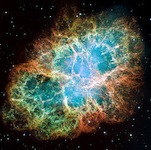

In 1584 Giordano Bruno suggested that the stars were actually other suns, and may have other planets, possibly even Earth-like, in orbit around them, an idea that had been suggested earlier by such ancient Greek philosophers as Democritus and Epicurus.
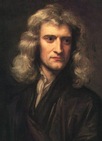
The Italian astronomer Geminiano Montanari recorded observing variations in luminosity of the star Algol in 1667. He did not understand he was seeing a binary star -- where the twin stars were rotating around each other.
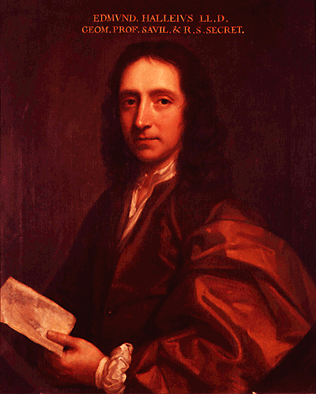
The first direct measurement of the distance to a star (61 Cygni at 11.4 light-years) was made in 1838 by Friedrich Bessel. Parallax measurements demonstrated the vast separation of the stars in the heavens. This again was revolutionary thinking. Humans were rapidly expanding their concepts of Space, Time, Biology. As the Firesign Theatre group said 1. "We're all Bozos on this Bus" and 2. "Everything we know is Wrong". Imagine the impact on the psyche of the scientists and intelligentsia of the times!
The science of stellar spectroscopy (identifying the luminosity and composition) was pioneered by Joseph von Fraunhofer and Angelo Secchi. By comparing the spectra of stars such as Sirius to the Sun, they found differences in the strength and number of their absorption lines—the dark lines in a stellar spectra due to the absorption of specific frequencies by the atmosphere. In 1865 Secchi began classifying stars into spectral types. However, the modern version of the stellar classification scheme was developed by Annie J. Cannon during the 1900s.
STAR SYSTEMS
Edward Pickering discovered the first spectroscopic binary in 1899 when he observed the periodic splitting of the spectral lines of the star Mizar in a 104 day period. Detailed observations of many binary star systems were collected by astronomers such as William Struve and S. W. Burnham, allowing the masses of stars to be determined from computation of the orbital elements. The first solution to the problem of deriving an orbit of binary stars from telescope observations was made by Felix Savary in 1827.
The twentieth century saw increasingly rapid advances in the scientific study of stars. Without getting too heavy (if I'm not already), Important conceptual work on the physical basis of stars occurred during the first decades.
SO WHERE CAN WE SEE TODAY?
There are a few exceptions. We have seen some individual stars in the M100 galaxy of the Virgo Cluster, that is about 100 million light years from the Earth! In the Local Supercluster, it is possible to see star clusters (next chapter).
However, outside the Local Supercluster of galaxies, neither individual stars nor clusters of stars have been observed. The only exception is a faint image of a large star cluster containing hundreds of thousands of stars located one billion light years away—ten times the distance of the most distant star cluster previously observed.
Well, that's about all I know about Stars. I hope you enjoyed this. I welcome comments and corrections.