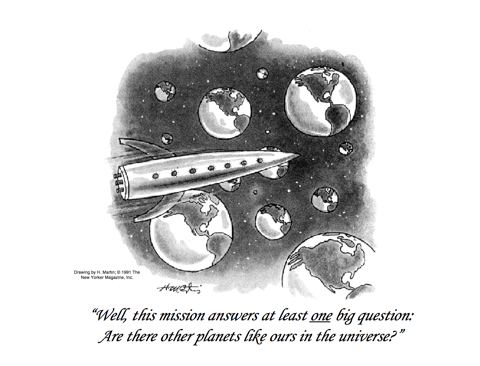
Since the times of the ancient greeks, and likely since we became sentient human beings, there has been the longing, or at least the curiosity, to know if we are alone in the universe, or if there are other beings on other planets. We may find out in our lifetimes.
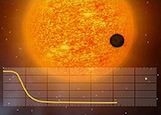
The second, more sophisticated method is where we look at the light change in the star, and if we see red light then blue light, this also means that something is orbiting. This "Radial Method" relies on the Doppler effect (or shift). The Doppler effect is that objects moving fast towards us show more as red light and objects moving away from us show more blue light.
The third method is to look for an odd-shaped star that has a ring around it that could be a system of comets and asteroids, much like our solar system.
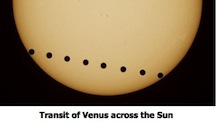
Since we began looking, we have found over 340 such planets. We call these -- exo-planets or extrasolar planets (Scientists can't agree). We have also found a handful of exo-solar systems -- where a star has multiple planets orbiting. In the 10 years, the space agencies have enlisted the help of amateur astronomers world-wide to track stars and report findings. People take images after images and studied for signs of apparent change in brightness of a star.
Another milestone. When the Hubble Space Telescope was launched in 1990, we had not yet discovered a single exo-planet. Now - 20 years later, Hubble is being used to determine the atmospheres of exo-planetts.
This may appear somewhat tedious. But then you find something like Formalhaut! Most exo-planets have been found using the Radial method, so far.

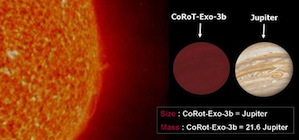
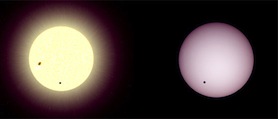
 here to see a little movie describing the CoRoT mission.
Previously, it discovered a planet only 5 times the size of Earth. These planets orbit a star named Gliese. Gliese, we now know has at least 3 planets and this last find maybe the first discovery of a habitable planet.
What is our criteria for determining if a planet is habitable? The image below depicts our current criteria:
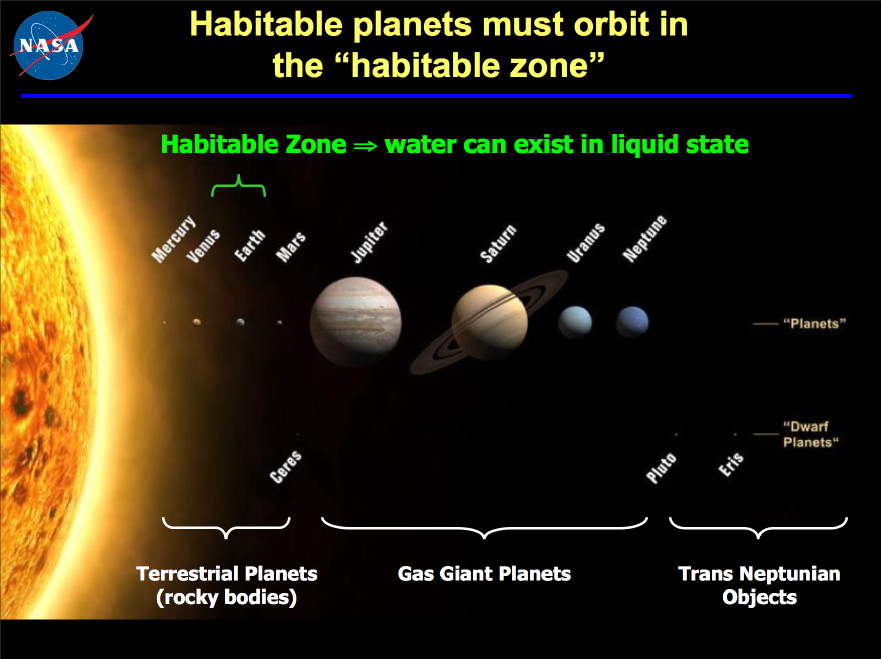
So, we are looking for planets as follows (M= Mass e= Earth, H= Hydrogen and He= Helium):
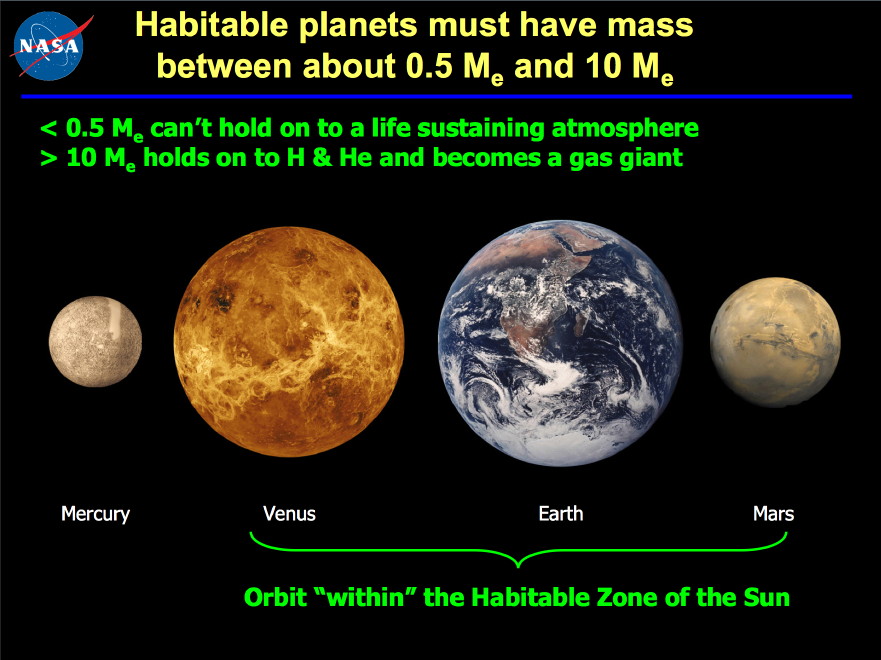
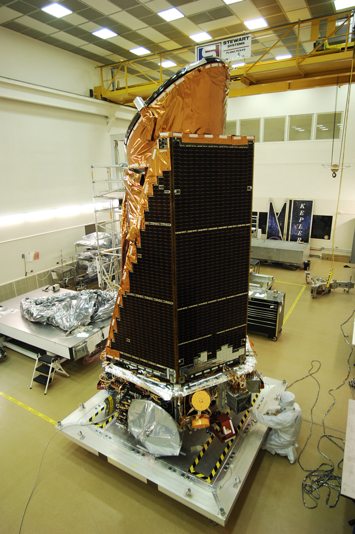
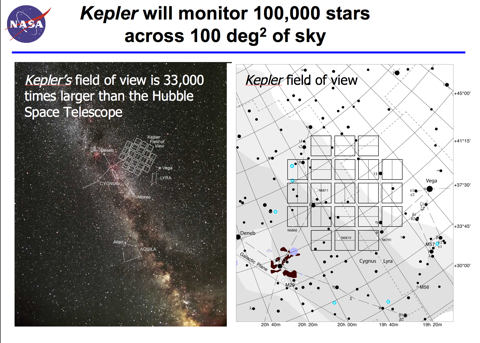
NASA has just launched a new space telescope that, among other work, will relieve this tedious task. Kepler, due to launch in early March 2009, will focus on an area of the sky in the Orion constellation, and can simultaneously watch 100,000 stars! This is a profound mission. By observing more than 100,000 stars, Kepler will make statistically significant measurements of the frequency with which terrestrial planets orbit in the habitable zones of stars in the galaxy. If such planets are common, Kepler will detect hundreds of them. If Kepler detects none, then Earth-like planets are very rare, and we may be alone in the galaxy.
The next two images show the size and structure of the telescope (compare the telescope to the size of the technician working on it:
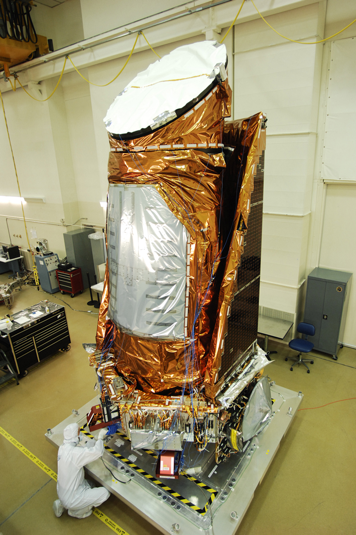
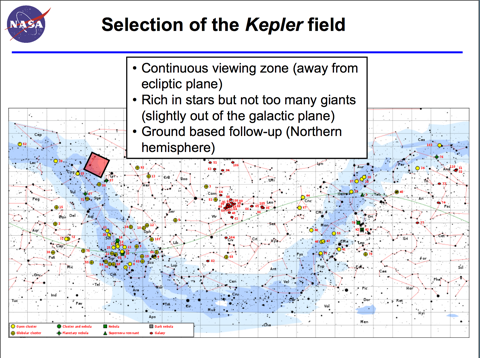
The following images show the area of the sky where Kepler will observe. This area was selected as it has a lot of stars similar in size to ours, plus it is an area of space where NASA's Deep Space Network can track it:
Within the red frame of the picture above, This is where Kepler will work:
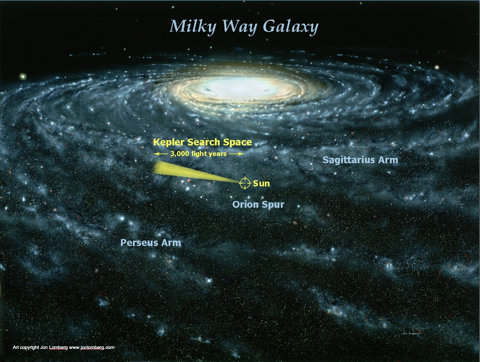
The next image shows an artist's rendition of this location in our galaxy (The Milky Way):
Finally, Kepler will hopefully answer our age old question: