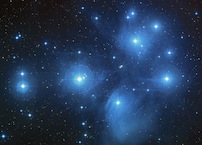
There are several types of Nebulae. What they have in common is that they are all huge gas clouds. They are generally the result of star explosions, areas where new stars are forming, or areas where there is not enough gravitational force to pull the gas into stars or galaxies of stars. Another thing they have in common is that they are all incredibly beautiful. They are relatively easy to see and image with backyard telescopes. Here are some examples and explanations.
STELLAR NURSERY
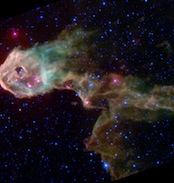
NASA's Spitzer Space Telescope captured this stellar nursery. It's called the Elephant's Trunk Nebula. This Nebula is an elongated dark globule in the Cepheus constellation. Within the globule, a half dozen newly discovered protostars are easily discernible as the bright red-tinted objects, mostly along the southern rim of the globule. These were previously undetected at visible wavelengths due to the thick cloud ('globule body') and by dust surrounding the newly forming stars.
The newborn stars form in the dense gas because of compression by the wind and radiation from a nearby massive star (located outside the field of view to the left). The winds from this unseen star are also responsible for producing the spectacular filamentary appearance of the globule itself, which resembles that of a flying dragon -- hence the name :)
PLANETARY NEBULAE
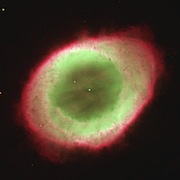
As you might expect from scientists, especially when they come together to decide something in a meeting, planetary nebulae have nothing to do with planets.
The mass that they shed is returned to the interstellar medium to eventually reform into new generations of stars. This will likely happen to our sun in about 6-7 billion years.
EMISSION NEBULAE
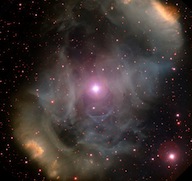
Here is a specific explanation of the image to the left: How did a star form this beautiful nebula? In the middle of this emission nebula (called by the romantic name: NGC 6164-5), you can see an unusually massive star nearing the end of its life. The star is so hot that the ultraviolet light it emits heats up gas that surrounds it.
That gas was likely thrown off from the star, possibly by its fast rotation, like a rotating lawn sprinkler.
Expelled material might have been further channeled by the magnetic field of the star, creating the symmetric shape of the bipolar nebula. Several cometary knots of gas are also visible on the lower left. This nebula spans about four light years and is located about 4,000 light years away toward the southern constellation Norma. So this nebula is four times larger than our entire solar system!
REFLECTION NEBULAE