So you’d like to look at the sky and learn a bit about it. What follows are some ideas and technologies for you. First get your feet wet, and your eyes familiar with the night sky. How? Here we go.
First, you could not have picked a better time. 2009 is the International Year of Astronomy! Check out their activities for students, young and old.
You could simply go to a library and read a book on astronomy, and learn constellations, names of stars. If you click on the Teen Space logo on the left, you will go to the Internet Public library - Teen Section. You can navigate from there.
Maybe a good library would have a star chart or sky map for you to keep. Google's is free, but you can't take it outside. Anyway, you can find a cheap map for less than $10.00. Next, there are some great magazines that always show you the constellations in the night sky. In the US, the two top paper and internet periodicals are Sky and Telescope and Astronomy. If you have kids that you’d like to teach, there is a site and magazine for them too. It’s here. If you are not in the US, there are equivalent magazines in many countries. Just do an Internet search (you can use the search bar to the left if you like.
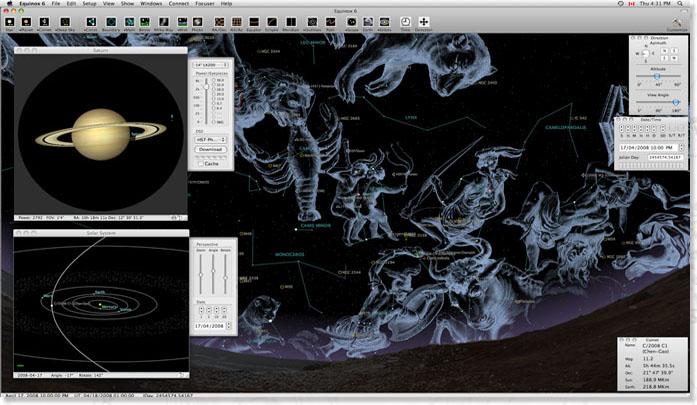
If you want to explore a little more, or have a birthday coming up, and have access to a computer, think about investing in some Astronomy Software. These programs essentially give you an observatory at your fingertips. There are some great software products for personal computers (In case you don't know this by now, I use a Mac but you might use something else - I wont condemn you publicly) that will help you learn the night sky. Three of the best (in my opinion) are Equinox, The Sky. and Starry Night. I find Starry Night a little overwhelming though. Other people may have other suggestions so look around. Try the search feature in this site for example.
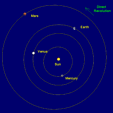
This software is extensible in that, as you get better at learning the night sky, and more interested in seeing things first hand, the software can be used with a telescope to help you find deep-space objects. Click on the image on the left and you'll see what astronomy or planetarium software looks like, and it is not expensive. Once, you're getting good, then have a look at subscribing to SkyInsight.
Once you're hooked, there are software products to stack astronomic photos, so you can get geeky and maybe even discover a comet, but by then, a) you wont need me, and b) maybe you can join the NASA/JPL program that I'm in and share your knowledge with your friends, families and communities.
As I keep saying, there is a deep and urgent need to learn and share the knowledge of what we are discovering today. We cannot let ignorance (the new Romans) take over, and unfortunately, we cannot rely solely on schools and others to teach us or our kids. We have to learn for ourselves. So get to it! We need engineers, astronomers, artists, whatever you want to be, we need you. Look at my site at careers. Brainstorm with your friends and family.
To be fair, the Vatican has (I’m told), an amazing observatory.
Ok. off the soapbox and back to pragmatics. If you're taken with the inexpensive software or, just want to see for yourself. Before I get into options, let me say this categorically:
NEVER, EVER, LOOK AT THE SUN DIRECTLY. AND THE SAME DOUBLED WITH AN ASTRONIMIC INSTRUMENT, UNLESS THE INSTRUMENT HAS A SOLAR FILTER.
Looking directly at the sun is bad enough, but the sun’s rays are stronger through binoculars and telescopes and can blind you. You can get a piece of film material to see the sun with your naked eye, but get it at a reputable camera or photo supply store.
Also another warning,
DO NOT LOOK AT THE MOON THAT IS MORE THAN HALF FULL THROUGH A TELESCOPE, WITHOUT A LUNAR FILTER.
That probably wont blind you, but it will definitely hurt. I know it from experience. OK, disclaimers out of the way, here are some options:
If you're taken with the software and/or you just want to see for yourself. here are some options:
Binoculars
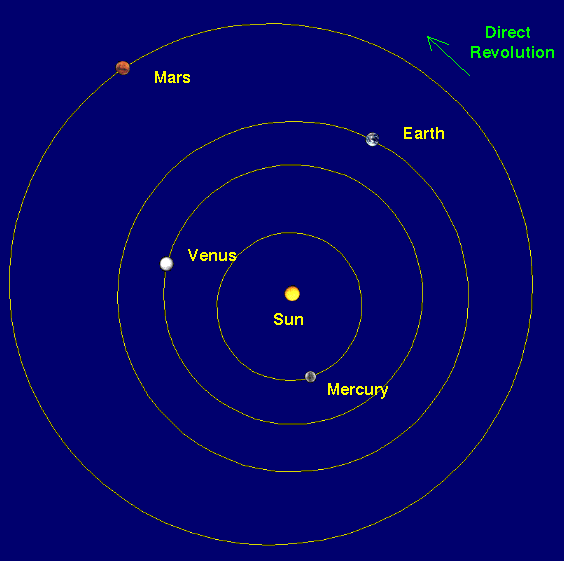
Most likely if you step out of your house at night and you live in a big city, you'll be mugged. But if you have a minute beforehand, you can look up and maybe see a bright star. That's Venus. (right now at least. Different planets are “up” at different times of the year).
Most people assume that Venus is the “star” in the evening sky, but you’ll learn that that is not always the case. Sometimes Venus is “up” in the morning, and sometimes it’s completely out of view. Check your software, star chart or magazine.
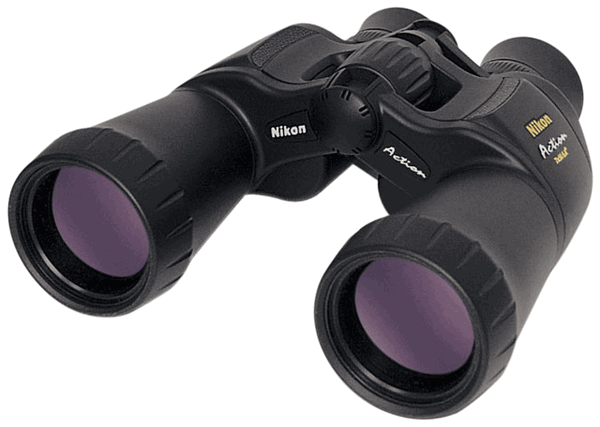
If you want to have a nice time, or your birthday is coming up, get your family to buy you a pair of binoculars, find a dark or wide place, and lie down and look. I do not suggest a park, unless it's safe or you're with friends. Perhaps a flat roof, or a country outing.
Halfway decent manufacturers are Meade and Celestron and they are not very expensive. Don't get very heavy ones or you wont use them. In fact, someone in your family may already have a pair. Even bird watching, ie small binoculars can be used to see craters on the moon and maybe even the Galilean moons of Jupiter. Unfortunately, Jupiter's moons will only appear as pinpoints surrounding our solar system's largest planet. And if you observe them two nights in a row, you will see the change as they orbit. For more advanced binoculars, I suggest Nikon and/or Canon. But don’t spend too much. For the price of expensive binoculars, you can get a pretty decent telescope!
Other than the manufacturers linked above, decent companies to buy binoculars and telescopes are: B&H Photo, Adorama and optcorp. The advantage of these three companies are that they have a wider range of products and better prices. Check out wherever you like. Amazon may also have decent products. Astromart is a great place where astronomers swap, buy and sell equipment.
If you want serious binoculars made especially for astronomic observing, they should be a minimum of 7 x 50. This site explains the measurements and what to look for. Paradoxically, city living is ideal for studying the planets, as a) not to many stars show, so it's easy to pick out the planets, and b) the atmospheric dust actually clarifies the view of the planets. I am serious when I say that once you have seen the moon through binoculars, you will be a changed person. Now remember that we have sent 12 people there. Amazing.
If you want to hear first hand their experiences, get the Discovery Channel series "When We Left Earth" or watch the film "In the Shadow of the Moon". A wonderful dramatization is Tom Hank's "From the Earth to the Moon".
Telescopes.
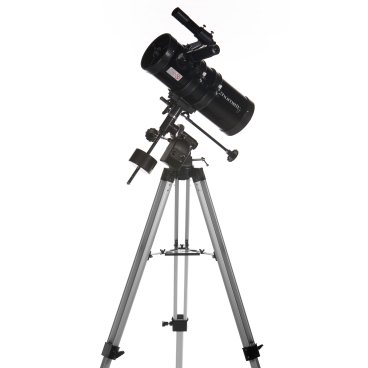
It doesn't matter if you are in an urban or rural area, but if you can wait a few years before you make your next mortgage payment or at least wait on buying a car, consider buying a telescope. There are several different kinds of personal telescopes that you can handle. I wont get into too much detail, but the three main kinds of telescopes for you and me are a Refractor - you look directly through the lens, a Reflector - you look through an eye-piece that shows light reflected through a series of lenses and mirrors, and Newtonian - something in-between.
I'm not serious. You can get a great telescope for $500 or less. Once hooked though, and especially if you want to get into Astro-Photography, you could spend a fortune!
Refractor
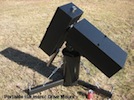
This is the type of telescope that Galileo built and used. They are still -- 400 years later -- extremely popular and range in price from a few hundred dollars (Orion) to several thousand (Takehashi). You look through the lens directly or with a 90° angle lens for ease of viewing. The little telescope on top of the big one is called a spotting scope and they help you find what you are looking for.
Reflector
There are several types of Reflectors: Schmidt-Cassegrain, Schmidt-Ritchey, Newtonian and Dobsonian. The all have the same basic principle of reflecting light off of a mirror onto the lens that you look through. My own telescope is a Schmidt-Cassegrain. If you click on the Reflector link above, you'll get more information on each. I'll just touch on some principles of purchasing one of these. Please please study a ton about telescopes before spending a lot on money on one. There are advantages and disadvantages to each of these, but the things to consider are: the quality of the optics, the size of the primary mirror, the cost, and the weight.
A 16" Reflector is so heavy, you will likely only be able to get it onto a permanent mount and leave it there, so while it will show magnificent views, it isn't exactly portable. Reflector Telescopes cost anywhere from $500 up to $10000 or more. And these are still consumer quality. So you must weigh the pros and cons, and like everything, there will be trade-offs.
I bought a 10" Meade LX-200GPS and schlapped it to Greece from the US. My wife still growls at me. But the views are worth it, and even she is awed by them. Still it was tough trying to get it through the Greek customs agents at 4am, until she said it was a very big camera lens, and they let us pass. For a price! Now I am starting to learn how to take astro-photographs through it. I may publish some here if they are decent.
If you're interested, join user forums on line (yahoo has great one, such as lunar-observing, binocular-observing, videoastro, , or even better, a local club or telescope group. These nutty folk are only too happy to show off their equipment, especially to noobies. The yahoo groups are friendly, helpful, and you'll see amazing images. Search for others too!
A few more thing about modern telescopes.
So we have a new generation of "armchair astronomers".
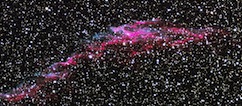
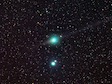
Before you think I am disparaging these people, I am most definitely not. Amateur astronomers, using consumer grade telescopes are responsible for an immense amount of today's knowledge of our solar system and beyond. Asteroids and Comets are named after their discoverers and most of these are amateurs. These insomniacs capture picture after picture of a portion of the sky and compare pictures laboriously. Every now and again, an object is seen that was not there during the previous observation. Excitement rains as the amateur calls in the coordinates to a tracking center, the siting is confirmed and the object is named and cataloged. The comet in the picture was discovered by an undergraduate student in China, and he was modest enough to name it after his school, not himself. It's Comet Lulin.
Enter the Internet
There is a rapidly growing community of companies and individuals who have built telescope arrays and will let you see through their telescopes. Three great sites to try this out are Slooh (we "slew" telescopes when we move from one celestial object to another), Lightbuckets.(slang for telescopes, and of course: telescopes.org All have various levels of service, ranging from them giving you guided tours of what they want to show, to you purchasing time on their LARGE telescopes and requesting to see various objects. As they will soon have global coverage, Slooh will have the capability to show people in the northern hemisphere, objects that only appear in the southern sky, and vice versa. If you have Windows, you can download Microsoft's WorldWideTelescope software. If you have an intel Mac, you can do the same :).
To read more about Amateur Astronomy, go to the Wikipedia Site.
One section in particular is of note and the links are below. These are some amateurs and their accomplishments. They represent a handful of people who have made skywatching a global - human - endeavor. We can't all pay gazillions to travel into orbit, but we can learn for ourselves where we are and what's around us.
George Alcock, discoverer of comets and novae.
John Dobson perfected the Dobsonian telescope mount that revolutionised the building of large-aperture Newtonian reflector telescopes for faint-object observing.
David H. Levy discovered or co-discovered 22 comets including Comet Shoemaker-Levy 9, the most for any individual. This comet smashed into Jupiter in 1995..
Russell W. Porter founded Stellafane and has been referred to as the "founder of amateur telescope making". This telescope, designed by Dr. Porter, is a wonderful example of art meeting science and technology.
Isaac Roberts was the first to apply photography to astronomy.
Amateur Thomas Bopp, a construction manager and amateur Astronomer shared the discovery of Comet Hale-Bopp in 1997 with unemployed PhD physicist Alan Hale.
Sir Patrick Moore, presenter of the BBC's long-running The Sky at Night and author of many books on astronomy.
Robert Owen Evans is a minister of the Uniting Church in Australia and an amateur astronomer who holds the all-time record for visual discoveries of supernovae,
and finally, you have to read this story.