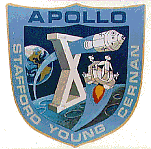
 APOLLO 10
Launched: 18 May 1969 UT 16:49:00 (12:49:00 p.m. EDT)
Lunar Orbit: 21 May 1969
Returned to Earth: 26 May 1969 UT 16:52:23 (12:52:23 p.m. EDT)
CREW:
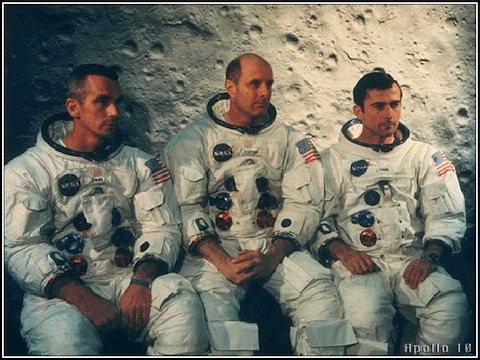
Eugene A. Cernan, lunar module pilot
Thomas P. Stafford, commander
John W. Young, command module pilot
MISSION DESCRIPTION
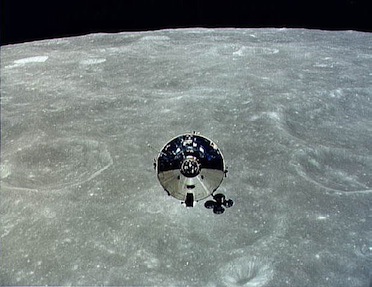
After launch, the spacecraft was inserted into a 189.9 km x 184.4 km Earth parking orbit at 17:00:54 UT, followed by translunar injection after 1 1/2 orbits at 19:28:21 UT. The CSM separated from the Saturn V 3rd stage (S-IVB) at 19:51:42 UT, transposed, and docked with the LM at 20:06:37. After a three day cruise, Apollo 10 entered an initial 315.5 km x 110.4 km lunar orbit on 21 May 1969 at 20:44:54 UT, using a 356 sec. SPS burn. A second SPS burn lasting 19.3 seconds circularized the orbit to 113.9 km x 109.1 km.
On 22 May Stafford and Cernan entered the LM and fired the SM reaction control thrusters to separate the LM from the CSM at 19:36:17 UT. The LM was put into an orbit to allow low altitude passes over the lunar surface, the closest approach bringing it to within 14 km of the Moon. All systems on the LM were tested during the separation including communications, propulsion, attitude control, and radar. Numerous close-up photographs of the Moon's surface, in particular the planned Apollo landing sites, were taken. The LM descent stage was jettisoned into lunar orbit. The LM and CSM rendezvous and redocking occurred 8 hours after separation at 03:22 UT on 23 May.
Later on May 23 the LM ascent stage was jettisoned into solar orbit, and on 24 May at 10:25:29 UT after 31 lunar orbits the CSM rockets fired for trans-earth injection. CM-SM separation took place on 26 May at 16:22:26 UT and Apollo 10 splashed down in the Pacific Ocean on 26 May 1969 at 16:52:23 UT (12:52:23 p.m. EDT) after a mission elapsed time of 192 hrs, 3 mins, 23 secs. The splashdown point was 15 deg 2 min S, 164 deg 39 min W, 400 miles east of American Samoa and 5.5 km (3.4 mi) from the recovery ship USS Princeton.
All systems on both spacecraft functioned nominally, the only exception being an anomaly in the automatic abort guidance system aboard the LM. In addition to extensive photography of the lunar surface from both the LM and CSM, television images were taken and transmitted to Earth. The Apollo 10 Command Module "Charlie Brown" is on display at the Science Museum, London, England.
APOLLO 10 PHOTOGRAPHIC ARCHIVE